How to discipline your child: time-outs


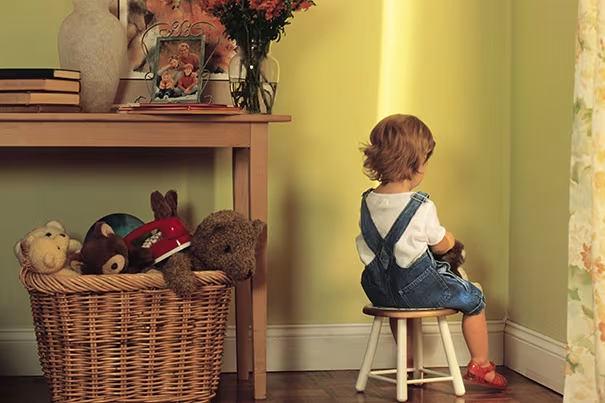
A time-out is a period during which a child is removed from the troublesome situation or temptation. It's their chance to calm down, regroup and remember what is expected of them.

Here's how to make time-outs an effective tool
Consider your child's age
Every child is different, children younger than 18 to 24 months old don't really understand the concept, and older kids generally need more sophisticated ways to learn how to behave well.
Follow through on rules
During a time-out, the child does not get to interact with the parent or care provider. A time-out is meant to be a minor form of isolation that says, in effect, 'When you do this, you can't be a part of things'.
Establish a pattern
This requires an initial investment of time that most parents find worthwhile. Resetting a child's expectations is harder than getting it right the first time, but it's still worth the time and energy.
Setting up a time-out
Place a chair in a safe but boring spot, such as the corner of a dining room or a rarely used entrance area. Be sure the place is away from care providers and the 'scene of the crime'. Being in the middle of things provides too much opportunity for compounding the problem with teasing and provocative behaviour.
Try not to use a child's bedroom can it can create negative associations with a place that should be a safe haven. A bedroom also tends to contain too many distractions.
Be sure the time-out location is a safe place where the child can be left alone without supervision. For example, the top of a staircase, near breakable items and next to a door that he can open are all NOT the places to choose.

How to carry it out
Warn first
After two warnings about the forbidden behaviour, announce, 'Okay, it's time for a time-out'. Nothing more. Pick up the child and place him in the time-out seat.
Set a timer
The duration should be about one minute per year of the child's age.
Be firm
If the child gets up, simply put him back in the chair and reset the timer. Don't say anything and don't give in.
Forgive and forget
When the timer goes off, say, 'It's all done now', give him a hug, and leave it at that. Don't mention the issue again. Give him something new to do, a positive alternative to the forbidden activity.
Common pitfalls
Talking too much
This only confuses the child, adds to the tension and upsets everyone. A simple statement of the transgression when the 'crime' is committed followed by 'It's time for a time-out' is enough.
Backfiring
If a time-out provides more attention to the child than he receives when he's behaving well, he'll continue to draw your attention with the provocative behaviour.
The parent is too upset
Take a second to calm down. Go back to your child, state the reason for the time-out, and put him in time-out. Be sure you save this scenario for the worst of 'crimes' rather than making it a habit.
Not rewarding good behaviour.
One approach is to 'catch him' being good. This is hard because as the misbehaviour escalates, your natural tendency is to push back and even try to avoid him.
Special circumstances
Behaviour
If your child is frantic or ill, he won't be able to learn from the time-out. For children who have experienced a lot of serious separations, time-outs bring up too much emotion, which overrides the learning opportunity.
Developmental age
Children who are developmentally delayed or very advanced in cognitive skills may need to be treated based on their developmental age rather than their chronological age.
Spending all day doing time-out?
If you find that your child is especially provocative, it might be because they're experiencing stress or pressure, or simply because he's bored. Ask yourself whether you're projecting stress – a child will do provocative things to pull you out of your shell, even if it means risking your anger.

Health review: 18-month-old baby check-up
At 18 months your baby will have developed greatly since their previous check-up. Find out what doctors will be looking for in advance of your visit.
Read more
Health review: 2-year-old check-up
See what you should prepare for your 2-year-old's check-up at their local general practitioner or paediatrician, to evaluate their development and health.
Read more
Health review: 3-year-old check-up
Find out what to expect during your 3-year-old child's scheduled baby check-up at your family doctor or paediatrician.
Read more
Stomach pain in children: Toddler tummy aches
Check out these quick tips to understand what commonly causes tummy aches for toddlers, and some simple remedies and activities to help stop them.
Read more
Staying Safe While Enjoying the Great Outdoors
Essential outdoor safety tips for toddlers to keep them safe whether you're camping far away or walking in a local park. Know what to do if anyone gets lost or separated and ensure a safe and fun experience outdoors.
Read more
Toddler Bath Time: How to Help Your Child Love Baths
Ringworm is a highly contagious fungal infection sometimes seen in babies. Learn our guide on how babies get ringworm, diagnosis and how to treat it.
Read more
Temper tantrums: Dealing with baby tantrums
Find out some of the best ways to deal with and mitigate temper tantrums with toddlers, to help prevent emotional development issues in early life.
Read more
Toddler Discipline: Beyond Time-out
Disciplining a child from a young age will help to encourage positive reinforcement within their emotional development.
Read more
Diabetes in Children: Causes, Signs, and Treatment
Diabetes in children is a chronic condition that appears at any age. Click here on Pampers India to read more on signs of diabetes in children, its causes, diagnosis, and treatment.
Read more
Discipline: How to talk to toddlers
View our step-by-step guide to learn how to effectively talk and listen to toddlers during discipline, so that they learn to express themselves correctly.
Read moreHealth review: 18-month-old baby check-up
At 18 months your baby will have developed greatly since their previous check-up. Find out what doctors will be looking for in advance of your visit.
Read moreHealth review: 2-year-old check-up
See what you should prepare for your 2-year-old's check-up at their local general practitioner or paediatrician, to evaluate their development and health.
Read moreHealth review: 3-year-old check-up
Find out what to expect during your 3-year-old child's scheduled baby check-up at your family doctor or paediatrician.
Read moreStomach pain in children: Toddler tummy aches
Check out these quick tips to understand what commonly causes tummy aches for toddlers, and some simple remedies and activities to help stop them.
Read moreStaying Safe While Enjoying the Great Outdoors
Essential outdoor safety tips for toddlers to keep them safe whether you're camping far away or walking in a local park. Know what to do if anyone gets lost or separated and ensure a safe and fun experience outdoors.
Read moreToddler Bath Time: How to Help Your Child Love Baths
Ringworm is a highly contagious fungal infection sometimes seen in babies. Learn our guide on how babies get ringworm, diagnosis and how to treat it.
Read moreTemper tantrums: Dealing with baby tantrums
Find out some of the best ways to deal with and mitigate temper tantrums with toddlers, to help prevent emotional development issues in early life.
Read moreToddler Discipline: Beyond Time-out
Disciplining a child from a young age will help to encourage positive reinforcement within their emotional development.
Read more