What to Expect from a 6-Week Ultrasound? 3D and 4D Scans Explained


Finding out you're pregnant is an exciting time of joy, high anticipation and a plethora of questions. One of the first and most crucial milestones in your pregnancy journey will be the 6-week ultrasound 3D. Your first scan is usually pretty informative of how your baby might be progressing and ensures everything is just right. If you wish to know what to expect from a 6-week 3D ultrasound scanning, then you’ve come to the right place.
This blog is a compilation of all the information you’d need on a 3D scan of a 6-week pregnancy. We answer important questions like why your doctor would send you for an ultrasound scan, what happens during an ultrasound scan and all the cool things you might experience with 3D and 4D ultrasounds.
Whether you are 6 weeks pregnant and anticipating your first 3D ultrasound or just need to find out what a 3D/4D ultrasound in 6 weeks is all about, we've got everything you need. Let's start this adventure together by learning about the wonderful world of early pregnancy imaging.
Why did your doctor order an ultrasound at 6 weeks?
A 6-week ultrasound 3D is quite typically included as part of the standard initial care for early pregnancy. It can give one an idea of how mature and healthy the embryo is. Here are five reasons your doctor may have requested you to do this early scan:
1. Early heart development
One of the common reasons for conducting a 3D scan at 6 weeks pregnant is to track the progress of early heart development. Most often, an ultrasound can pick up a heartbeat at this stage. Seeing the heartbeat so early in pregnancy can be a great way to alleviate anxiety and ensure that the pregnancy is healthy and active.
2. Number
A 6-week 3D ultrasound can detect the number of embryos. This is especially crucial in women who have received some kind of fertility treatment, as their chances of multiple pregnancies (twins, triplets, etc.) are increased. The knowledge of how many embryos there are helps prepare for the pregnancy better.
3. Where Does the Baby Lie?
An early ultrasound can establish that the pregnancy is indeed located within the uterus. This helps to rule out the possibility of ectopic pregnancies, where the embryo implants outside the uterus, usually in the fallopian tubes. Ectopic pregnancies can be life-threatening and must be treated promptly.
4. Size
The ultrasound can then measure the size of the embryo. This can help determine the expected due date. With precise dating, the baby's development can be monitored, and the timing of subsequent prenatal tests and ultrasounds can be determined.
5. Yolk sac
The yolk sac, which is an early source of nutrition for the embryo, can be visualised on a 6-week ultrasound 3D. A thick yolk sac along with its presence indicates a healthy pregnancy, whereas an abnormal yolk sac in some cases may indicate potential issues that need to be monitored closely.
What Are Ultrasounds Used for In Pregnancy?
1. First Trimester Ultrasounds
Ultrasounds in the first trimester are performed to determine the following factors:
2. Second Trimester Ultrasounds
An anatomy scan is performed during the second trimester, between 18 and 20 weeks into the pregnancy. This ultrasound will evaluate the following:
3. Third-trimester Ultrasounds
In the third trimester, ultrasounds are also effective in monitoring baby growth and movement and checking placenta and amniotic fluid levels.
What Happens At A 6-Week Ultrasound Scan?
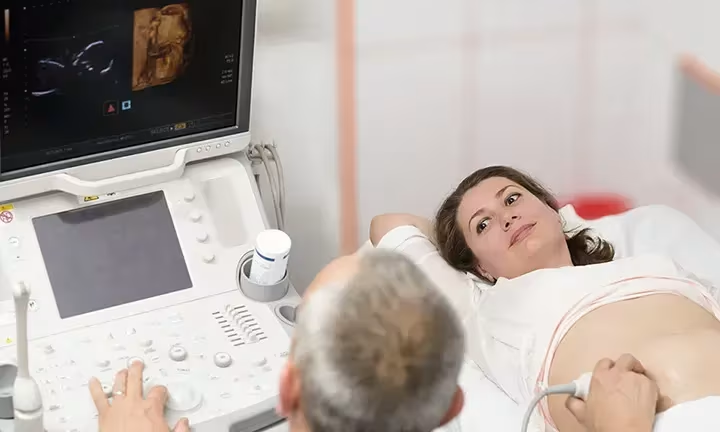
A six-week ultrasound is typically done transvaginally rather than abdominally as it provides you with a better view of the embryo in the early stages of pregnancy. Abdominal ultrasounds are usually performed after 7 weeks. For an abdominal ultrasound, you have to lie down while a technician applies a certain type of gel on your tummy. This will help carry the sound waves. The technician will then place a probe against your tummy and move it around to get an image.
A transvaginal ultrasound, on the other hand, requires inserting a probe into the vagina. While it shouldn't be painful, it might be somewhat uncomfortable.
How Are 3D and 4D Scan Special?
A 3D ultrasound provides a three-dimensional view of the baby. A conventional 2D ultrasound provides only a flat, two-dimensional view. However, with a 3D scan, you can see even the superficial features of the baby. This would be less possible at 6 weeks because of the very small size of the embryo.
A 4D ultrasound adds the dimension of time to the 3D image and gives the impression of a live video. This way, you get a glimpse at the baby's movements in real life. The size of the embryo at 6 weeks is not much more than a dot and movements can hardly be seen at this stage. Thus, 4D ultrasound might not be far ahead of a 3D scan at 6 weeks, but with each passing week, it will definitely capture some fascinating moments in the life of the baby, like yawning or stretching.
Conclusion
All types of ultrasound tests including 2D, 3D or 4D ultrasound at 6 weeks, can be used as a fundamental tool for the conduct of early pregnancy care. It can give you important information about your baby’s heartbeat, the number of embryos and placement of the baby. Although 3D and 4D scans provide images with a higher resolution, along with real-time video, their benefits are more discernible when the pregnancy progresses. Early ultrasounds provide crucial information that can help you plan out prenatal care and management, and sometimes even identify any problems early.
Articles Related To Labour & Delivery

Preparing For Labor and Delivery
Retrieving data. Wait a few seconds and try to cut or copy again.
Read more
What to Expect After Birth
Get prepared for postpartum with our essential checklist. Navigate the whirlwind of delivery room activity confidently. Learn about breastfeeding after birth & postpartum care.
Read more
The Full Prenatal Care Guide
Prenatal care guide: Ensure a healthy pregnancy with expert advice from a prenatal care doctor. Discover how Pampers IN can support your journey.
Read more
Top 9 Postpartum Workout Ideas
Reclaiming your pre-baby fitness can be tough. Discover top postpartum exercise ideas and tips to kickstart your journey back to shape after pregnancy!
Read more
Lochia: Is Postpartum Bleeding Normal?
Postpartum bleeding, known as lochia, is a part of your body’s natural recovery mechanism. Click here on Pampers India to know more about what bleeding after delivery entails!
Read more
Benefits of postpartum massages for new mothers
Discover how postpartum massages aid recovery, reduce stress, relieve pain, and promote better sleep after delivery for new mothers.
Read more
20 Affirmations to Prepare for Labour and Delivery
Empower yourself with pregnancy affirmations for a calm labor, positive birth experience, and a confident mindset for delivery.
Read more
What Is a Mucus Plug, and What Happens When You Lose It?
Learn about the mucus plug during pregnancy, including what its role is, what losing your mucus plug could mean, and how these changes indicate labor.
Read more
What Are 3D and 4D Ultrasound Scans?
Discover the enhanced clarity of 3D and 4D ultrasound scans in pregnancy. Learn all you need to know about these advanced imaging techniques, with insights from Pampers IN.
Read more
Prenatal Ultrasounds
Discover the significance of prenatal ultrasounds, an unforgettable moment for parents-to-be. Learn all about ultrasound scans during pregnancy with insights from Pampers In.
Read morePreparing For Labor and Delivery
Retrieving data. Wait a few seconds and try to cut or copy again.
Read moreWhat to Expect After Birth
Get prepared for postpartum with our essential checklist. Navigate the whirlwind of delivery room activity confidently. Learn about breastfeeding after birth & postpartum care.
Read moreThe Full Prenatal Care Guide
Prenatal care guide: Ensure a healthy pregnancy with expert advice from a prenatal care doctor. Discover how Pampers IN can support your journey.
Read moreTop 9 Postpartum Workout Ideas
Reclaiming your pre-baby fitness can be tough. Discover top postpartum exercise ideas and tips to kickstart your journey back to shape after pregnancy!
Read moreLochia: Is Postpartum Bleeding Normal?
Postpartum bleeding, known as lochia, is a part of your body’s natural recovery mechanism. Click here on Pampers India to know more about what bleeding after delivery entails!
Read moreBenefits of postpartum massages for new mothers
Discover how postpartum massages aid recovery, reduce stress, relieve pain, and promote better sleep after delivery for new mothers.
Read more20 Affirmations to Prepare for Labour and Delivery
Empower yourself with pregnancy affirmations for a calm labor, positive birth experience, and a confident mindset for delivery.
Read moreWhat Is a Mucus Plug, and What Happens When You Lose It?
Learn about the mucus plug during pregnancy, including what its role is, what losing your mucus plug could mean, and how these changes indicate labor.
Read more